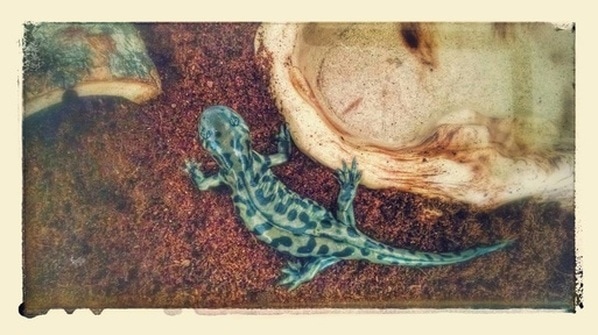
 One of our Tiger Salamanders, Parker
Tiger Salamanders are tied with Giant Salamanders for the record on the largest terrestrial salamander species, reaching lengths of up to 14 inches. They can be found in the woodland areas throughout most of North America, from northern regions of Mexico to the southern regions of Canada. Their color patterns may vary with specific species, but most are dark brown in color with lighter marking that can range from a muted grey to a bright yellow. As a burrowing species, Tiger Salamanders are rarely seen out in the open. They prefer to spend most of their time about two feet under the surface. These voracious predators consume a variety of insects, slugs, and earthworms. Like many other amphibians, Tiger Salamanders will eat their skin after shedding. Tiger Salamanders reach sexual maturity after the first year. Females tend to have a more rounded figure. Males tend to have a slimmer build with flat tales. Their cloaca may appear swollen compared to the females. The Tiger Salamander is considered the State Amphibian of both Colorado and Kansas. In many places it is illegal to sell adult specimens to discourage the pet trade from taking specimens from the wild. The state of Colorado also has limitations on which species can be possessed in captivity. Quick Overview
Tiger Salamanders are popular as pets due to their simple care requirements. A 10 gallon tank is large enough to keep one individual. Multiple salamanders can be housed together, but they should be similar in size and feeding should be monitored to make sure that each individual gets enough to eat. Some salamanders may appreciate a shallow water dish, but they do not require one as they absorb moisture through their skin from the substrate. They appreciate areas to hide such as a log or a fake plant, but most will burrow in the substrate. Live plants that are not toxic can also be used in the enclosure with the understanding that the salamander may occasionally dig up the plant. They do not require additional heating or UVB lighting as long as the enclosure is in an area that is room temperature. At Ferrets and Friends, LLC our Tiger Salamanders are fed two to three times per week. They each eat about three to five crickets per feeding, depending on their appearance. Tiger Salamanders will become obese if they are overfed. Animal Care Cost Example (2017 Prices): Set Up
Animal Care Cost Example (2017 Prices): Annual Cost
2 Comments
Tom Cosgrove
12/12/2023 10:27:35 am
I'd like to buy the setup above. How do I place an order? Leave a Reply. |
About the blogFerrets and Friends, LLC has four writers bringing you information on a variety of topics from pets to wildlife, education to conservation, and from new developments in our business to information about our industry. Learn something new each week! Archives
August 2020
Categories
All
|
 RSS Feed